
Bollards can be an extremely effective form of physical security for a business. In order to make them as robust and efficient as possible, they need to be fit for purpose and placed correctly around the site.
When conducting a site survey, it is imperative that the entire surroundings are taken into account, especially if the site has vehicle access, as you need a thorough understanding of what the security risks are and how bollards can help potentially reduce this threat. Security bollards can be an effective solution to some security risks including speeding drivers and vehicle attacks. Here is our guide to security bollards.
Why should bollards be used?
There are many reasons why bollards should be used on some sites to boost their overall physical security. Here are just a few of the reasons why businesses can benefit from installing bollards:
• They deny entry to vehicles into certain areas without the need to restrict pedestrian entry or install a barrier or gate
• They are a great safety measure to protect pedestrians from vehicles
• Rising bollards help restrict vehicular entry to areas during certain hours rather than it being a permanent fixture. This provides businesses with a lot of flexibility over their security measures
• They prevent vehicles from getting too close to or damaging property or buildings
• The more robust Hostile Vehicle Mitigation (HVM) bollards are specifically designed to protect sites from terrorist vehicle attacks
• They can blend in well with their surroundings when designed and implemented correctly and feel less intrusive than some other forms of physical security
Crash rated and non-crash rated bollards
Security bollards tend to be split into two broad categories: crash rated and non-crash rated. Crash rated bollards have been put through rigorous testing by government-approved bodies and determine the level of resistance.
Non-crash rated bollards are still robust and a great form of protection, however they are not designed to be completely resistant to vehicle crashes. As their resistance power is not as robustly tested as crash rated bollards, they are best suited for lower-risk sites.
Anti Terrorist Bollards
Our X Pass and Ranch range are all crash tested and certified by an accredited laboratory according to the latest international standards. Their hydraulic power packs are independent to each other, meaning that if one fails, the other bollards will remain unaffected. They are fitted with anti-tampering kits as standard and are the perfect choice for protecting more sensitive sites.
Automatic Bollards
Automatic bollards use a simple yet effective electrohydraulic mechanism that ensures a smooth and efficient movement of the bollard. They are great for areas where you will sometimes need to allow access for vehicles but not all the time. The automatic bollards give a business complete flexibility over the timings.
The GA7276H Automation Bollard from Gateway Automation is controlled by a CDS dedicated control unit, which is capable of controlling up to four bollards simultaneously. For added safety, they are fitted with obstacle detection and a crown of LED lights is mounted on top of the cylinder along with a built-in acoustic warning signal.
Pedestrian Flow
A thorough understanding of pedestrian movement through the site is vital for arranging bollards. Sites must ensure that pedestrian movement is still comfortable and convenient. They should not be placed where pedestrian conflicts occur, such as areas of limited visibility, and the height of bollards need to be considered. This is especially important during winter months when lighting is not as great.
Bollard Spacing
Spacing between bollards is also an important consideration that businesses need to look at. It is essential that the gaps are not big enough to allow vehicle access but are large enough for disabled people to access. There must always be enough space for easy wheelchair action. An absolute minimum is 1000mm.
When planning the bollards, the spacing between each one should be equal wherever possible. They should also be at least 500mm away from the edge of roads.
It is also important that no chains or rope are used between barriers. Doing so can cause hazards for blind or partially sighted people and can put them at risk.
Which bollard is best?
When choosing which bollards are best, there are no strict guidelines. Choosing the best bollard is completely dependent on the site in question and what their requirements are. From knowing their needs and their vulnerabilities, an appropriate bollard can be chosen and installed. It is important you determine where you are planning on placing the bollards and then decide which type you go for.
A Guide to Security Bollards


Bollards – a vital tool to protect the public from vehicular assaults
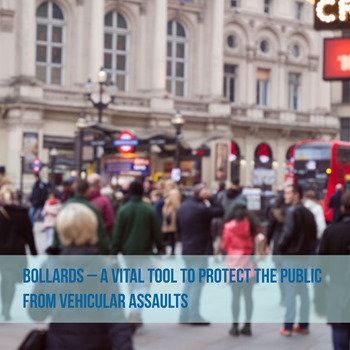
While bollards have always played a crucial role in defending pedestrians from road traffic accidents and diverting traffic away from areas where there are lots of people on foot, today we see their role being adapted for a new purpose – defending against terrorist attacks.
Over the past few years, terrible attacks against pedestrians have been witnessed in some of the world’s biggest and most populous cities including Barcelona, Charlottesville, Berlin, London, New York, Nice, Stockholm, and the West Bank. The attacks have seen vehicles being used as weapons and driven into large groups of people causing mass casualties and deaths.
This new form of terrorist attack presents challenges to the security services as they are often unexpected, and can be undertaken without too much advanced planning and preparation. In some cases, the drivers have then gone on to exit vehicles and begin a melee attack on innocent pedestrians who are left standing after the attack, and this continues until emergency services are able to make it to the scene and apprehend the attackers.
To prevent these kinds of attacks, many city planners and organisations are turning to security tools such as bollards to deter vehicular assaults and stop terrorists in their tracks. Iconic landmarks such as London Bridge and York Minster are being fitted with anti-terrorist bollards to provide protection against impact collisions from vehicles, thereby protecting flocks of tourists who visit these landmarks every day.
Here at Gateway we provide a range of equipment which can be used down to halt vehicular attacks including Crash Tested Road Blockers and purpose built Anti-Terrorism Bollards like the XPass B 330/1200, XPass B 275/800 and Ranch D 275/800. To find out more, please call us on 01522 682 255 or click here to arrange a callback.
Maritime Security: the role of Access control at ports and harbours

First, it’s important to understand that, as with almost every type of premises, there is no ‘magic bullet’ solution to deal with the threat of crime. Any approach to security at ports and harbours should revolve around a holistic strategy. This means a combination of both physical security options like access control equipment, lighting and CCTV as well as operational security through manned guarding and checkpoints, as well as a company culture that puts security and identification at the forefront of operations.
What role can access control equipment play?
In a nutshell, access control equipment serves to control the access of vehicles and of persons into a port or harbour. This in turn can help to reduce the threat of smuggling, disruption to trade, theft and potential terrorist attacks. Every port is of course different, and measures need to be identified appropriately through a risk assessment, but there are several options available which will likely have a positive impact in the protection of a port or harbour.
One of the toughest security solutions that we provide is the GA80000 Automatic Rising Kerb. A formidable first line of defence against unwanted vehicle access, it is a strong visible deterrent with yellow and black warning stripes and tall stature to stop cars, vans and lorries.
We also offer anti-terrorism bollards and impressive crash-tested road blockers to deal with potential terrorist attacks aimed at disrupting UK infrastructure.
Barriers are an important way of controlling access to only authorised and scheduled visitors. We provide fully automatic barriers which can be controlled by push-buttons, tokens, proximity cards, pins, CCTV or by on-site security guards.
Swing gates, sliding gates and bi-folding gates are among the strongest barriers to unauthorised entry and a strong physical deterrent.
Gateway Automation can help the maritime industry to protect their assets from crime with minimum disruption and while maintaining safe and comfortable working environments for staff and customers. For a free non-obligation quotation and feasibility survey please contact Gateway Automation on 01522 682255. Alternatively, our brochure can be downloaded here: http://www.gatewayautomation.co.uk/brochure/.